The night watchman’s encounter in the mirror
Blind Willow, Sleeping WomanThe night watchman’s encounter in the mirror is a remembered episode in which an ordinary overnight school round turns into a terrifying confrontation with an apparent double—and ends with the discovery that no mirror was ever present. The event’s decisive revelation is not supernatural: the watchman identifies the figure as himself, and the experience leaves him afraid of what the self may contain.
Background and Setting
The watchman tells the story more than ten years after it happened, introducing it at a gathering where others have shared frightening experiences. Until that night, he had never told anyone: even speaking about it seemed capable of making it happen again. His delayed account frames the episode as a private fear reluctantly made public.
He had graduated from high school near the end of the 1960s, amid the student movement, and refused to go to college. Instead, he traveled around Japan doing manual labor. During the autumn of his second year on the road, tired from summer work, he took a two-month job as night watchman at a junior high school in a small town in Niigata Prefecture. At eighteen or nineteen, he considered himself unafraid.
The school was a relatively new, three-story concrete building with roughly eighteen to twenty classrooms, a music room, library, gym, auditorium, cafeteria, swimming pool, and other facilities. He slept in the janitor’s office during the day and made two rounds at night, at nine and three, checking twenty points on a list. Rather than mark off the checklist from bed, he walked the route, partly because he did not want to risk being attacked if someone broke in.
The Night Round
The encounter took place on a windy, unusually humid night at the beginning of October. Mosquitoes swarmed, and he burned repellent coils. The pool gate was broken, so the wind repeatedly banged it open and shut. The watchman’s nine o’clock round passed without incident: the doors were locked, everything seemed in place, and he returned to the janitor’s room to set his alarm for three.
When the alarm woke him, he felt an inexplicable resistance to getting out of bed, unlike his usual habit of rising quickly. The pool gate still banged, but its familiar rhythm now seemed altered. He nevertheless forced himself up, reasoning that abandoning a duty once would make it easier to abandon again. He took a flashlight and a wooden kendo sword and began the round.
The night grew stranger as he went. The wind strengthened, the air became more humid, and his skin itched enough to make it difficult to concentrate. He checked the gym, auditorium, and pool first; everything was in order, though the gate’s irregular banging seemed almost to alternate between nodding and shaking its head. Inside the school, the checklist also disclosed nothing unusual. Relieved, he headed back toward the janitor’s room, with the boiler room beside the cafeteria—the final point—still to check.
His return route took him along a long, dark first-floor hallway. A typhoon nearby had hidden the moon, leaving the corridor black except when the clouds briefly parted. His basketball shoes squeaked on the green linoleum as he hurried toward the janitor’s room. Passing the entrance, he thought he saw something in the darkness, broke into a sweat, tightened his grip on the wooden sword, and turned his flashlight toward the wall beside the shoe-storage shelf.
The Apparent Double
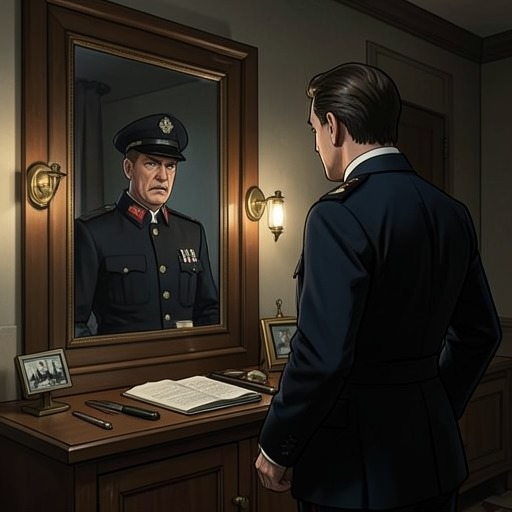
At first the discovery seemed mundane: a full-length mirror had apparently been installed since the previous night. Startled, the watchman recognized his reflection and felt foolish for having reacted so strongly. He lowered the flashlight, took out a cigarette, and lit it. A faint streetlight reached the mirror through a window, while the pool gate continued banging behind him.
After a few puffs, he noticed that the reflected figure was not simply an image of him. It looked exactly like him outwardly, yet seemed to be another self, one that should never have existed. He understood this double as filled with an immovable hatred, like an iceberg in a dark sea. The cigarette slipped from his fingers; its reflected counterpart fell too. He remained fixed in place, staring at the figure as though bound hand and foot.
Then the reflection’s right hand moved. Its fingertips touched its chin and crept slowly up its face. The watchman realized that he was making the same movement, and felt as though the figure were trying to take control of him. The threat therefore becomes more intimate than an intruder or ghost: the apparent other is visibly joined to him through the very gestures of reflection, while seeming to embody a self he cannot accept as his own.
Flight and Aftermath
Summoning what he describes as his last ounce of strength, the watchman roared, broke free of his paralysis, raised the kendo sword, and smashed the mirror. He heard glass shatter but did not look back. He raced to his room, locked the door, and leapt under the covers. Though he worried about the cigarette he had dropped, he would not return for it. Outside, the wind continued to howl, and the pool gate kept banging until dawn.
By sunrise the typhoon had passed. The watchman returned to the entrance and found the cigarette butt and wooden sword, but no mirror; in his account, there had never been one. Those objects remain as physical traces of his flight, while the supposedly shattered glass leaves no corresponding evidence. The daylight check overturns his initial explanation without offering another material cause for what he saw.
The watchman rejects the possibility that he encountered a ghost and concludes that what terrified him was himself. He says that the thought that the most frightening thing in the world is one’s own self always returns when he remembers the night. The experience also shapes his later life in a concrete way: his house contains no mirrors, and learning to shave without one proved difficult. The episode thus ends not with the fear fully dispelled, but with a lasting avoidance that registers its force.